



They’re Big, Bad and Back — Little Angels are supporting their first studio material in 32 years with a full headline tour across the UK. Original Angels fan and Rushonrock Editor Simon Rushworth reminisced with frontman Toby Jepson…
Rushonrock: When Little Angels burst out of Scarborough did it feel like there was a gang mentality shared by the British rock bands breaking through at the time?
Toby Jepson: The first thing to say is you don’t know that you’re part of gang — or in a scene — when you’re in it, if you know what I mean. I think we’d spent quite a lot of time finding our way into a scene, even though we didn’t know there was a scene going on! We were just a bunch of kids from the North East of England and all we wanted to do was to emulate our heroes. Our whole forward motion was based on this kind of positive, unrelenting, total sense of self-belief — it was all about getting out on the road and playing shows. Along the way we met Wolfsbane and Tigertailz and then we realised there was a bunch of British bands breaking through. We crossed paths with them all through what was an amazing club scene.
Rushonrock: So are you saying the so-called ‘Brit-rock scene’ of the late 90s crept up on you?
TJ: I think we were part of something for a while before we realised it. There were a load of bands that rose at the same time and I think we all had one thing in common— we’d seen bands like Van Halen and Bon Jovi break through big time in the mid 80s and we wanted a piece of the action! Our eyes were trained on the previous generation and we didn’t really notice that something new was happening. In Little Angels we’d all been aware of the New Wave of British Heavy Metal — and I was a massive Maiden fan as a kid — but it didn’t feel like there was a new scene in the late 90s. And certainly not a scene we were part of.

Rushonrock: When did it become obvious that there was something special happening in the rock clubs up and down the UK — that you were very much part of?
TJ: I don’t think anyone noticed it was going on until it started to really happen. When we all got record deals — we got signed to Polydor with The Almighty, and Thunder and The Quireboys got signed to EMI. We met Ricky Warwick quite early on and then we realised ‘hang on, there are quite a few new rock bands making a bit of a noise right now’. They all had major deals and everyone was at the same stage, all rising at the same point. But that breakthrough didn’t happen straight away for Little Angels. It was only when Radical Your Lover started to get radio play that we really felt part of things.
Rushonrock: It was a vibrant scene but there wasn’t a common sound — the new wave of British bands breaking through in the late 80s and early 90s were a varied bunch!
TJ: We were all uniquely different and that’s what I love about that period. We couldn’t be more different to Thunder. Thunder couldn’t be more different to Wolfsbane. Wolfsbane couldn’t be more different to The Quireboys. But there was space for all of us. And that was what was great about it. We all had this unique position and occupied a little pocket of time. Looking back on that time with rose-tinted glasses, I think we were all very, very lucky.

Rushonrock: Prior to Radical Your Lover crashing the charts, were the early days a bit of a struggle?
TJ: We signed to Polydor in 1988 and we put out our first album, Don’t Prey For Me, the following year. And it was a struggle. I won’t lie. It was a baptism by fire. We didn’t know how to make records. And we were thrown into the maelstrom of all of that label stuff — everything that entails being part of a major record company. It was a totally different way of thinking and for the first time it felt like work. Things changed from us being kids in a garage somewhere — or in a barn, in our case — to, all of a sudden, huge amounts of money being invested in our band. We felt the pressure.
Rushonrock: Just how difficult was that transition?
TJ: I remember one of the key things for me was we went and worked with Eddie Kramer — the famous producer who produced Led Zeppelin, Hendrix and many more. We were put in Rockfield Studios with him to allegedly make our first record. And it was an unmitigated disaster! That was partially because we weren’t ready for it and he just didn’t get the band. It just didn’t work. That was a real moment where we thought ‘oh my God, this isn’t what we expected to happen at all’. But even Eddie Kramer couldn’t make Little Angels the next Led Zeppelin. That was never the idea, anyway.

Rushonrock: How did you keep it all together in the early days?
TJ: We experienced a lot of learning curves but what was great about that period was that we were always very resilient. We still are. We still feel very connected to each other and back then we supported each other and realised, collectively, that we had to work in a different way. We’d played She’s A Little Angel on Top Of The Pops and that gave us a huge amount of confidence. Sure, we had a stutter start making the first record — we just didn’t know what to do and probably let our nerves get the better of us. Don’t Prey For Me’s singles didn’t chart inside the Top 40 but then we made we made the decision to re-record Radical Your Lover.
Rushonrock: And that was a turning point?
TJ: It was the turning point. We went in a studio for 24 hours with a guy who was a fledgling producer at the time — Stephen Harris — and we laid down a new version based on our own instincts. Jimmy (Dickinson), our keyboard player, deserves all the credit because he completely reinvented the song. I’d originally written it with Bruce (Dickinson) and Dan Reed and it appeared on the first version of Don’t Prey For Me but I don’t think any of us realised how good that song really was. Our manager had spotted something though and he persuaded us to re-record it. We were quite resistant at the time but he insisted. It was the best thing we ever did. We went back to basics and trusted our feelings.

Rushonrock: What happened next?
TJ: Radical Your Lover just erupted. We went from playing in front of 150 people to playing in front of 500, 600, 750 people pretty much overnight. We were driving up to Middlesbrough to play the Town Hall Crypt on the day that the single hit the charts. Mark Goodier, the DJ, played it twice on his Radio One show which was unprecedented at the time. And we went in the charts at 32 or whatever. We’d broken the Top 40 for the first time and, all of a sudden, everything changed. It was just crazy. We were playing the Crypt the day after but the promoters moved us to the main room because they’d been inundated with people who wanted to come and see us play. We went from selling 150 tickets to selling 500 tickets in 24 hours. That was the power of radio back then — you got on Radio One, you got in the charts and, all of a sudden, people looked at you differently. That was a massive breakthrough moment.
Rushonrock: So prior to that ‘overnight’ success was patience and self-belief the key?
TJ: I’ve mentioned how we didn’t notice what’s happening. In our case it was a very slow, incremental climb. We’d spent the previous 18 months struggling and wondering what’s going to happen. Polydor were getting a bit nervous. But it only takes that one correct decision. I think we realised that this business is about one thing and one thing only — the songs. When it comes down to it, it all comes down to the songs. And I think I started to emerge as the principal songwriter in lots of ways during the Don’t Prey For Me process. I wrote Don’t Pray For Me, No Solution and Big Bad World and I started to realise I was a songwriter. Up until that point we’d been collectively songwriting but we started to identify where our strengths were. Bruce was really getting his hands around the fact he was an absolutely amazing riff writer and a cool guitar player. Jimmy was very much a sort of an architect of the sound in general and we had that great rhythm section with Mark and Michael. Everyone was finding their place. You might think success happens overnight but it doesn’t. You spend years and years and years in a room trying to figure it out and trying to figure out who you are. But Radical’s success taught us a big lesson — that songs are the most important thing. I think it stood the test of time, that track.

Rushonrock: Having hit your stride did you feel Young Gods was a better representation of Little Angels?
TJ: Going into Young Gods, it was an entirely different kettle of fish. We had I Ain’t Gonna Cry, Boneyard and all these big tunes that consistently broke the Top 40. The thing is with the Angels is that we’ve all got very eclectic tastes and Young Gods was an ambitious record with plenty of twists and turns. Jim’s into dance music as well as into classic rock and he always was. He was always into Kraftwerk and Erasure and bands like that. And I think we all recognised how good those bands were in their own market. We’ve never been po-faced about being a rock band. And you know, if you don’t call us heavy metal, we’re not going to fucking torture you! We always thought that was ridiculous. We were just into great songs, great bands, whoever they were. But of course, our shared loves were Def Leppard, Van Halen, Bon Jovi and Iron Maiden. It was all of those bands that made us feel excited. It was all to do with guitar playing and big drum sounds.
Rushonrock: Did you feel anything was possible where Young Gods was concerned?
TJ: It was a tapestry of all of our interests in different sounds and the different approaches to making music. There was never a time where I would bring in an idea and the rest of the band would go ‘oh, no, that sounds a bit too much like John Lennon or whatever’. The band would embrace it. Or if Jim brought in a sequence — like he did for She’s A Little Angel — none of us ever went ‘oh, we’re not using that’. We went ‘great, how can we integrate that?’. So we were all very open to the concept of using all of our influences. How do we make the best of them? Young Gods was a culmination of that. I mean, there’s a lot of stuff going on in that record. My only regret? It was maybe three songs too long. There were a couple of songs that we could have put to one side and concentrated more on the meat and potatoes in the middle of the record. But that’s hindsight, you know. It was an ambitious record. We took a long time to make that record. But I think it’s our best album in lots of ways — so far!

Rushonrock: Did the ambition, experimentation and vision set Little Angels apart?
TJ: Well we were always learning. It was a massive learning curve and we always kept an open mind about it. That’s what I love about the guys in the band. There was never any hard ‘no’. It was always ‘yes, what can we do next?’.
Rushonrock: And of course you embraced the horn section. Another bold move?
TJ: I think so. It might sound completely crazy but one of the common denominators in the band is Blues Brothers-style rock. We all loved the rock and soul of the 50s and 60s — we were brought up on it through our parents. My dad was a massive fan of soul music and he kind of came from the original mod period. He used to ride around on a Lambretta wearing a Parker when he was a kid. He went to see The Who at the Kursaal in Southend! So I was brought up in that world. My dad loved R&B, he loved those big Stax records and I did too. Coincidentally that struck a chord with Bruce and Jim. But their dad was into things like Eddie Cochran and Buddy Holly, and so they brought all that stuff to the table. That Americana sound and the horns were inbuilt and then the Blues Brothers film came out when we were teenagers. It brought all of those childhood influences together — the horns, the guitars, the boogie and rock and roll. It was good time, high energy music that underpinned Little Angels from day one. It was always in the background and so when the horn thing started to happen for us it felt like a natural move. Also Aerosmith, on Permanent Vacation and with Dude (Looks Like A Lady) nailed that sound. We loved it because it completely spoke to us.
Rushonrock: How much did Scarborough shape Little Angels?
TJ: We were really fortunate that when we were teenagers in Scarborough, there was a fantastic music scene — specifically at the Stephen Joseph Theatre. The guy that used to be the musical director was massively into all types of music and he used to put on these amazing Sunday night concerts. We were exposed to all of these amazing bands from across the region including Zoot And The Roots. They were a blues review band — with a horn section and a Hammond organ — and they had an incredible vocal arrangement. It was R&B and blues and powerful, pumping rock and roll. They really influenced us and then when we heard Aerosmith it all made sense. We actually ended up working with the trumpet player from Zoot And The Roots, Grant Kirkhope, who ended up becoming one of the key members of the Big Bad Horns. Grant was brought up on things like Judas Priest and he was a massive heavy metal fan so he plays his trumpet a bit like a lead guitar! Bringing in the Big Bad Horns definitely separated us from the pack — it gave us a different dimension and we used it correctly. That all stemmed from those Sunday nights in Scarborough!

Rushonrock: And the horns are still a key part of the signature Little Angels sound…
TJ: We tried it for the first time on Radical Your Lover and we’ve never looked back! The horn riff makes that track in many ways. The new material has horns all over it. It’s still our secret weapon.
Rushonrock: Talking of the new material — it’s 32 years since the band released new music. Why is that?
TJ: Honestly, I’m still not sure why. When Jam went to number one we felt on top of the world. It was the stuff of dreams. I don’t know anyone who goes into a rock and roll band and doesn’t want to have lots of success and who doesn’t want to be in the public eye. If they say the opposite then they’re lying. A lot of the reason why we do this as musicians is because we want to demonstrate our music, we want to be heard, we want to make noise, we want people to enjoy it and we want to entertain. So getting a number one record meant we’d kind of achieved a level of success that was beyond any of our expectations and beyond any of our dreams. You would have thought, wouldn’t you, that would be the pinnacle and it would be 100 per cent positive. But, of course, internal fractures were beginning to appear and we were under a lot of pressure. I can remember having a conversation with one of the Polydor executives on the day we went to number one. I went bounding into the green room of wherever we were and I’d heard the news about half an hour earlier. I was full of it. I was saying ‘oh my God, it’s wonderful, isn’t it, that we have this number one record’ and this exec said to me ‘yes, it’s great, but now we need another one’. That’s what they said and so we weren’t even allowed to enjoy it. We were still just kids really — in our late to mid-20s — and we just weren’t prepared for this corporate machine.
Rushonrock: So are you saying that your greatest success was also the beginning of the end for the band?
TJ: We just weren’t equipped to deal with it emotionally and we couldn’t understand why. It was a confusing time and we felt very pressurised. It felt like everything was about the future rather than enjoying the here and now. I will say that those tours, Jammed On Demand and Jammed Every Night, were still incredible because where we come alive is on the stage. We were always so happy in each other’s company and especially during a gig. Those two hours on stage every night on those tours were some of the happiest moments of our lives.

Rushonrock: So how difficult was it to call time on Little Angels in 1994?
TJ: Very difficult. I can only speak from my own personal perspective — and as a band we’ve talked about it endlessly — but I was very confused by the whole thing. We were mates but somehow, because of the pressures, we were starting to find it difficult to be completely honest with each other. Nobody had taught us how to deal with each other as we grew up in the music industry and problems began to surface. At the same time Nirvana had happened. I can remember going into a record shop in Bradford, just before we played St George’s Hall, and there was this amazing song blasting through the speakers. I asked the guy behind the desk who it was and he said they were a new band called Nirvana who, he was sure, were going to be massive. That was the first time I heard Smells Like Teen Spirit and I remember thinking to myself that times are changing. It was completely different to what we were doing so you knew something was coming around the corner and so did the record labels. That didn’t help. But when the band decided split up, to this day, I don’t really remember ever sort of saying to each other, ‘right, we’re splitting up’. It just kind of weirdly happened over a short of period of time.
Rushonrock: You clearly regret how things played out?
TJ: I do. Suddenly we’re announcing final shows and the messages were confused. There wasn’t a lot of communication going on and, all of a sudden, the end was upon us. I regret that because I wasn’t smart enough or grown up enough in that moment. I didn’t really know how to deal with what was happening and I think that if I’d had the head on my shoulders that I have now, back then, things might have been different. I would have sat us all down and knocked our heads together and gone ‘come on guys, you know, look what we’ve got going on here — we’ve had a number one record and 10 Top 40 records, what more do we need? Let’s just take a bit of time off. Let’s regroup in a couple of years’. Just like Def Leppard. I spoke to Joe [Elliott] about this at length, not all that long ago, and he said ‘we just realised we had to just take some time off and take some time away from each other’. I regret it the way it ended.

Rushonrock: Until now you’ve never recorded any new material under the Little Angels name — was that ever a possibility?
TJ: I’d never do that. I got asked by Frontiers if I’d front a version of Little Angels and I just turned it down flat. That’s not the band. I am not the band. The reason why Little Angels works is because it’s Little Angels. It’s because Bruce is a fucking awesome guitar player and because Jim’s an astounding keyboard player. Mark Plunkett’s my oldest mate. We’ve known each other since we were eight-years-old. God rest his soul, poor Michael [Lee] is no longer with us but we got Mark Richardson from Scarborough as well. He’s an astounding drummer. Without all of those pieces in place it really isn’t Little Angels. I even felt that when we toured in 2012 and we had Dominic [Greensmith] from Reef play the drums, it wasn’t quite right. He’s a lovely lad. I love Dom to bits and he did a great job but it wasn’t Little Angels to me. This time around, it’s entirely different. We’re all back and it feels like we’re properly back.
Rushonrock: The big difference between now and 2012 is that there’s new music alongside the shows. Was that always the plan?
TJ: My whole approach when we started having the conversations about doing some shows — and we’ve been having that conversation for the last four years — was to get the band back together properly. But for that to happen you’ve got to get your stars to align, you’ve got to get your ducks in a row. You’ve got to find a situation where everyone’s got the time to do it and everyone’s got the headspace and the emotional time to do it. We had those conversations and it was never about making new music, even from the start. It was like ‘we’ll go out and do some more shows’ and we all agreed that would be a great thing to do. But all the time I was thinking — and I made my voice known — how do we go about that? If you go out and do another nostalgia run, that’s all it is. I didn’t want to do that. At the time I was doing reasonably well in Wayward Sons. It wasn’t Little Angels but I was enjoying being a creative and writing songs for that band. And so when we actually made the decision to do this tour I said to the guys ‘look, we ought to have some new songs’. I felt we’d be mad not to have some new music because the fans are going to want that. Nobody wanted this tour to be a one-off. Everyone wanted to do more. So we needed some new music!
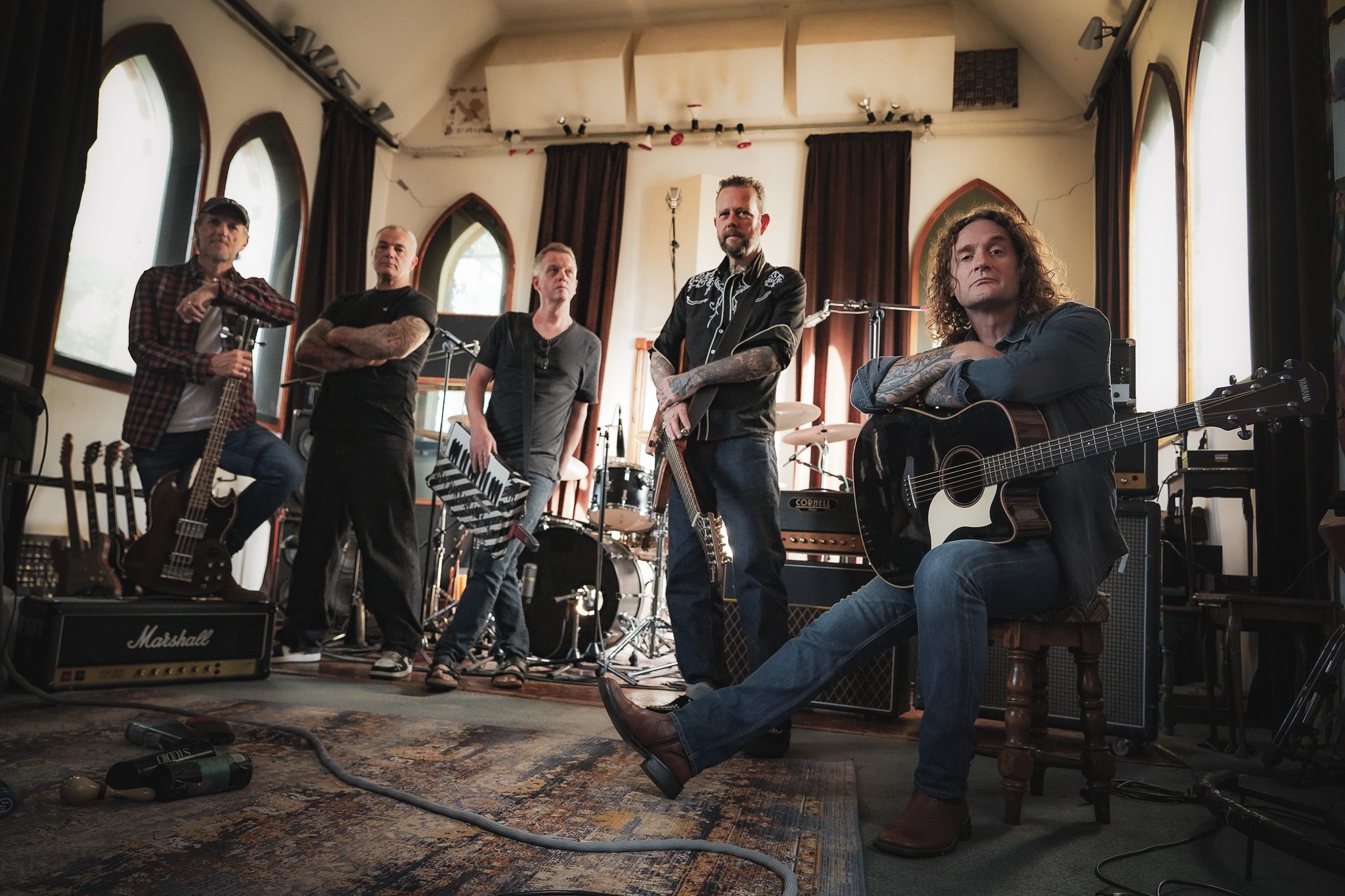
Rushonrock: How did that work out in practice?
TJ: Initially there were some nerves around writing brand new material. How do you take what we used to be back in the early 90s — at the height of the band’s success — and bring things bang up to date? How do you bridge that gap between a bunch of young lads in their 20s and a group of guys in their 50s? We’re not kids from Scarborough any more. We’re not teenagers trying to escape the town and all of that. So what would we write about? That’s where the nerves kicked in. Initially the idea was that we were going to take some of the old songs, that we didn’t think had enough of a focus on them back in the day, and revisit them. We were going to do an EP featuring a few deep cuts that we didn’t really do a good enough job on 30-odd years ago. That was very much in play. And the new EP does feature a reworked version of I Want Love, called You Want Love. But even then I’ve rewritten it completely. And when we actually got down to business it became clear we should write some new songs. After all, that’s all I do!
Rushonrock: It’s what you do but you hadn’t done it as a Little Angels for decades…
TJ: True. I hadn’t written a song in the Little Angels headspace for a long, long time. But I had a conversation with Bruce and he said something really pertinent to me. He said ‘you know what these new songs need to be? They have to be about us going home. This is not about us leaving town anymore. This is about us reflecting and looking back on what we were. It’s about returning home’. And the moment he said that, the penny dropped for me and I went home and I wrote more than 60 working ideas for a Little Angels record. Bruce is writing stuff now. Jim’s got stuff. We’ve got the bit between our teeth. We know what we need to do now. And the Big Bad & Back EP is representative of that bridge between what we were and what we’re going to be. But I don’t think we’ll do the same again. I don’t think you’ll hear more songs like Heroor Small Town Boys. We’ll make an album next year that looks to the future but this EP is a way of saying we’re back. We recognise who we were but this is what we’re going to do. It’s forward motion.
Little Angels kick off their headline tour in Dublin tonight (November 9). For the full run of dates click here.